
Louisiana Police Records
Louisiana police records include arrest reports, crash records, incident reports, and criminal history documents maintained by the Louisiana State Police and parish sheriff offices across 64 parishes. Louisiana operates as a closed record state, meaning criminal history information is restricted from general public access except in specific circumstances. Some records are available to individuals and approved agencies depending on the type and status of the case. This guide covers what police records you can access in Louisiana, which offices hold them, and how to submit a request in your specific parish or city.
Louisiana Police Records Quick Facts
What Louisiana Police Records Include
Police records in Louisiana cover a wide range of documents. These include incident reports filed when officers respond to a call, arrest reports created at booking, crash reports for traffic accidents handled by state or local police, and background check results from the Louisiana State Police. Each record type comes from a different source, and some are easier to get than others. The type of record you need and where the event took place determines which office you contact.
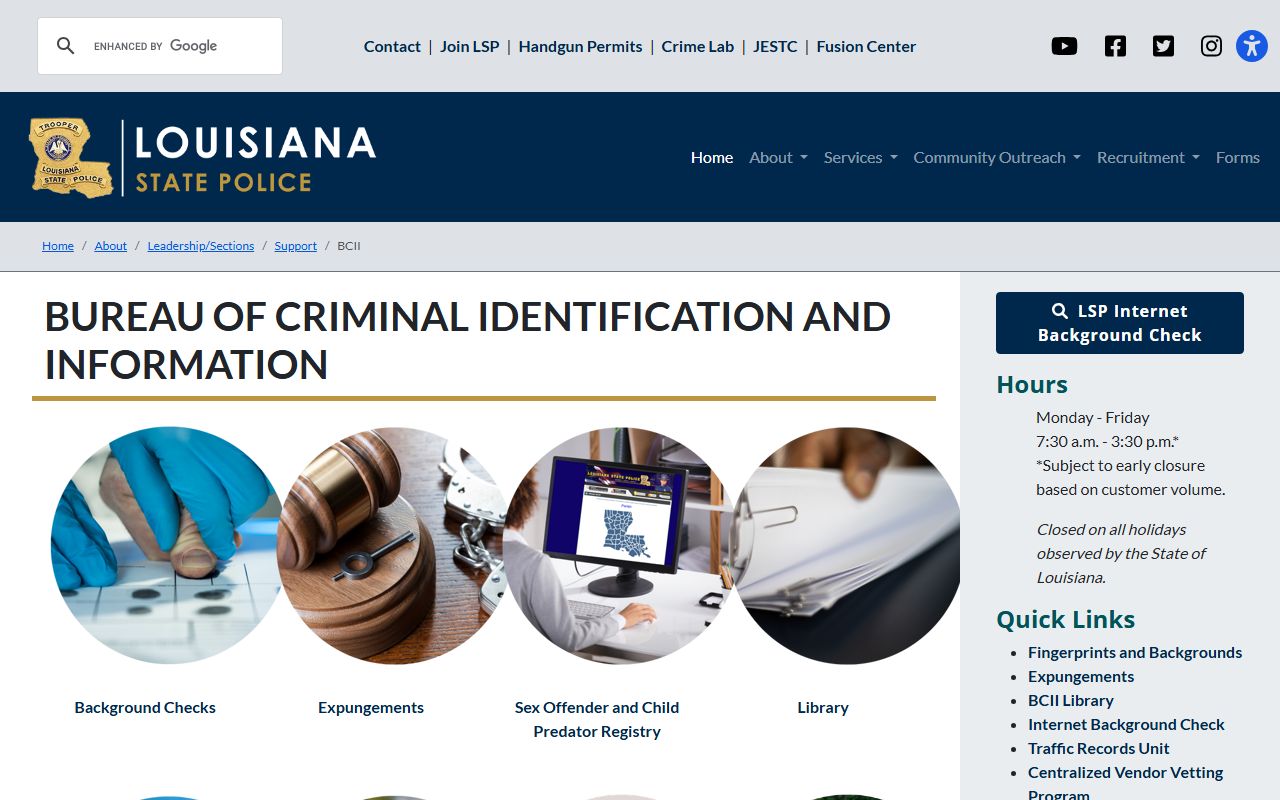
The main agency for state-level criminal records is the Louisiana State Police, Bureau of Criminal Identification and Information (BCII-LCJIS). This bureau runs the Louisiana Computerized Criminal History (LACCH) system, which holds arrest and disposition data, probation and parole bookings, and incarceration information. The LACCH does not include records from other states. For local incident and arrest records, you contact the parish sheriff's office or the city police department where the event took place. Many parishes also allow the public to view completed reports in person or online once a case has been resolved.
Not all police records are open. Louisiana law draws a clear line between records that can be released and those that stay restricted.
Criminal History and Closed Record Rules
Louisiana is a closed record state for criminal history under La. R.S. 15:587. The BCII-LCJIS records are not available to the general public. Only agencies authorized by statute can receive that information. These include criminal justice agencies, certain state licensing boards, health care providers, day care operators, and entities specifically listed under state law. A standard public records request will not produce someone else's full criminal history from the Louisiana State Police.
That said, other types of police records have different rules. The Louisiana Public Records Act, La. R.S. 44:1, gives any person 18 or older the right to inspect and copy government records. The Louisiana Constitution, Article XII, Section 3, reinforces this with a direct right to examine public documents. For police records that fall outside criminal history, like completed incident reports, many are available after a case closes. Under La. R.S. 44:3, records tied to open criminal investigations are exempt. Once the matter is resolved, many of those reports become accessible.
For most people, the practical ways to get Louisiana police records are the Right to Review process for personal records, crash report orders, and completed incident reports from the relevant agency.
Louisiana Police Records Background Checks
The Louisiana State Police processes background checks through its LSP background check services page. A standard state background check costs $31.00. Effective December 1, 2024, a $5.00 technology fee was added to all requests under La. R.S. 15:587 D(1), bringing the base total to $36.00 for state checks. Federal checks saw a $1.25 fee reduction effective January 1, 2024. The background check draws from the LACCH system, which contains arrests and their dispositions, booking data for probationers and parolees, and incarceration records going back many years.
Who can request checks on others is tightly controlled. Louisiana State Police will not run background checks for personal use, immigration matters, litigation, or residential rental screening. Out-of-state employers may request checks on their own employees and receive conviction data only. Out-of-state adoption agencies may request checks on prospective adoptive couples or foster parents and receive arrest and conviction information. All other authorized agencies must have an approved account and a signed User Agreement Contract with LSP before using the Internet Background Check portal.
In-person requests at LSP headquarters require a $31 money order and a separate $10 money order for fingerprinting, both payable to the Dept of Public Safety. Valid state-issued ID is required. Mail requests need fingerprints, the authorization form, the disclosure form, and a $31 money order sent to Bureau of Criminal Identification, P.O. Box 66614 Mail Slip A-6, Baton Rouge, LA 70896. The office is at 7919 Independence Blvd, Baton Rouge, LA 70806. Hours are Monday through Friday, 7:30 a.m. to 3:30 p.m. Call (225) 925-6095 for the Criminal Records Office. Mail processing takes 15 to 21 business days.
Online Background Check Portal
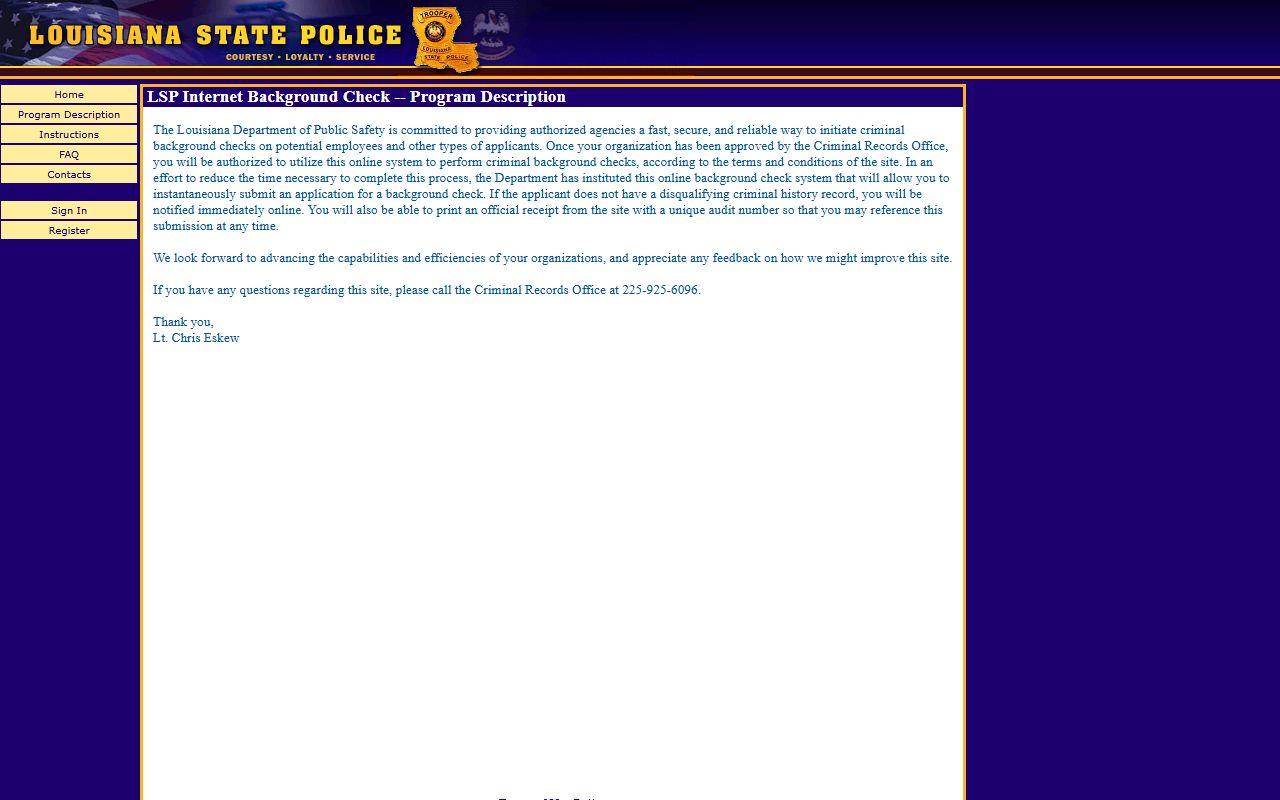
The IBC portal gives approved organizations a secure way to submit background check requests online. Once your organization is approved and has a signed contract with Louisiana State Police, you can submit up to 20 requests in a single transaction. The system sends immediate notification if an applicant has no disqualifying history. Each submission generates an official receipt with a unique audit number for tracking. For questions about approval, call the Criminal Records Office at (225) 925-6096.

The IBC FAQ page covers hours, fees, payment methods, and who qualifies. The portal runs 24 hours a day, 7 days a week. Sunday maintenance brings it down from 7:00 a.m. to 4:00 p.m. Payment through the portal takes Visa, MasterCard, Discover, and American Express. Processing for requests with no record typically completes within 24 hours. Requests that require fingerprint verification can take 15 to 21 business days.
Crash Reports and Traffic Records
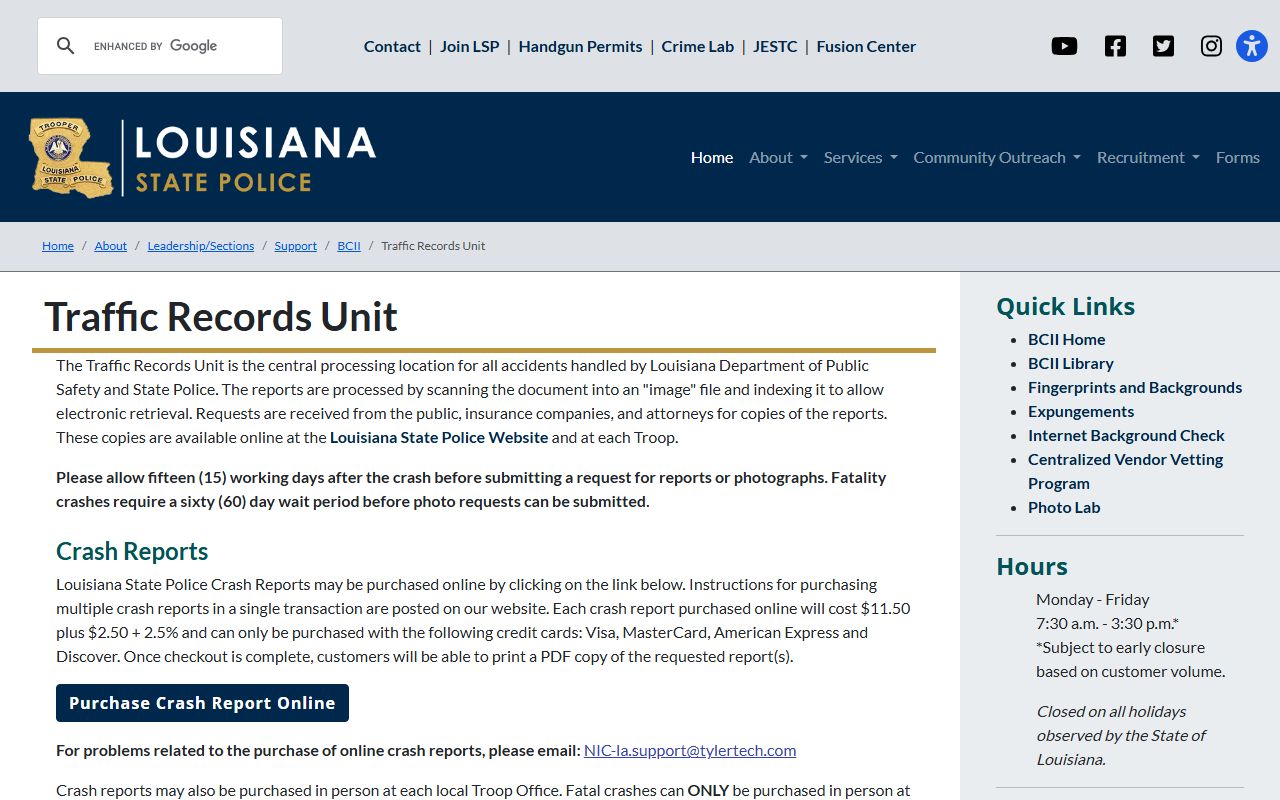
Traffic crash reports rank among the most requested police records in Louisiana. The Traffic Records Unit at Louisiana State Police handles all accidents managed by state troopers. Reports are scanned and indexed for electronic search. You can buy a report online through the LSP crash reports page for $11.50 per report, plus a $2.50 processing fee and 2.5% charge. Reports cover incidents from January 1, 2006 to present. After checkout, a PDF is available for immediate printing. To search online, you need either the report number or the driver's last name, combined with the crash date and street name.
Standard crash reports require a wait of at least 15 working days after the incident. Fatal crash reports need 60 days and can only be purchased in person at a Louisiana State Police Troop office. For photo requests related to crashes, contact the Traffic Records Photo Lab separately. Send requests to P.O. Box 66614 (Box A-27), Baton Rouge, LA 70896. Phone: (225) 925-4922. Email: lsp-trafficrecords@la.gov. In-person crash reports at a Troop office cost $16.50. A printed request form is available on the LSP website for in-person submissions.

For crashes handled by local city or parish police, go directly to that agency. State Police only manages reports for troopers, not local departments.
Right to Review Your Own Record
Under La. R.S. 15:588, individuals can request a certified copy of their own criminal history. This is called a Right to Review. Two formats are available. A mailed copy is a physical document stamped "True Copy," signed, and embossed with a raised state seal. This format is recommended for official purposes like expungement filings. An electronic Right to Review arrives as a secure email link, valid for one access only and viewable only on a computer, not a mobile device. It expires after 30 days and serves personal inquiry only.
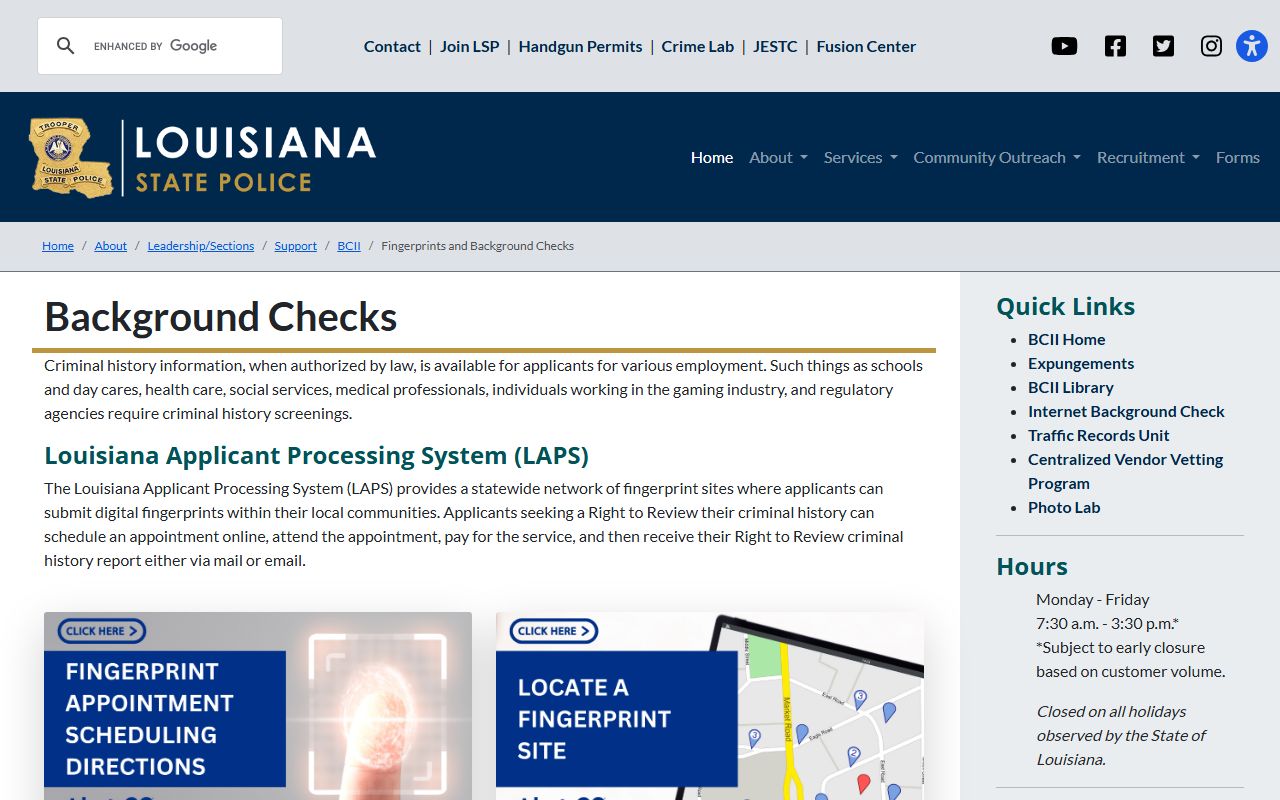
Walk-in appointments at LSP headquarters are no longer accepted. The Louisiana Applicant Processing System (LAPS) now handles this through the IdentoGO network, with over 100 livescan sites across Louisiana. Schedule an appointment online, attend with valid ID, pay the required fees, and receive results by mail or email. Keep your security question and answer safe. If you lose that information, you cannot retrieve your results by any other means and must schedule a new appointment from scratch. Results can only be accessed on a computer, not a phone or tablet.
Department of Corrections Police Records
The Louisiana Department of Public Safety and Corrections runs its own public records process separate from the State Police. Under La. R.S. 15:574.12, offender records are not generally public. However, certain details are accessible: an offender's age, the offense, the date of conviction, the length of sentence, and any documented misconduct during incarceration. The DOC does not conduct background checks. For criminal background checks, contact Louisiana State Police directly at (225) 925-6095.
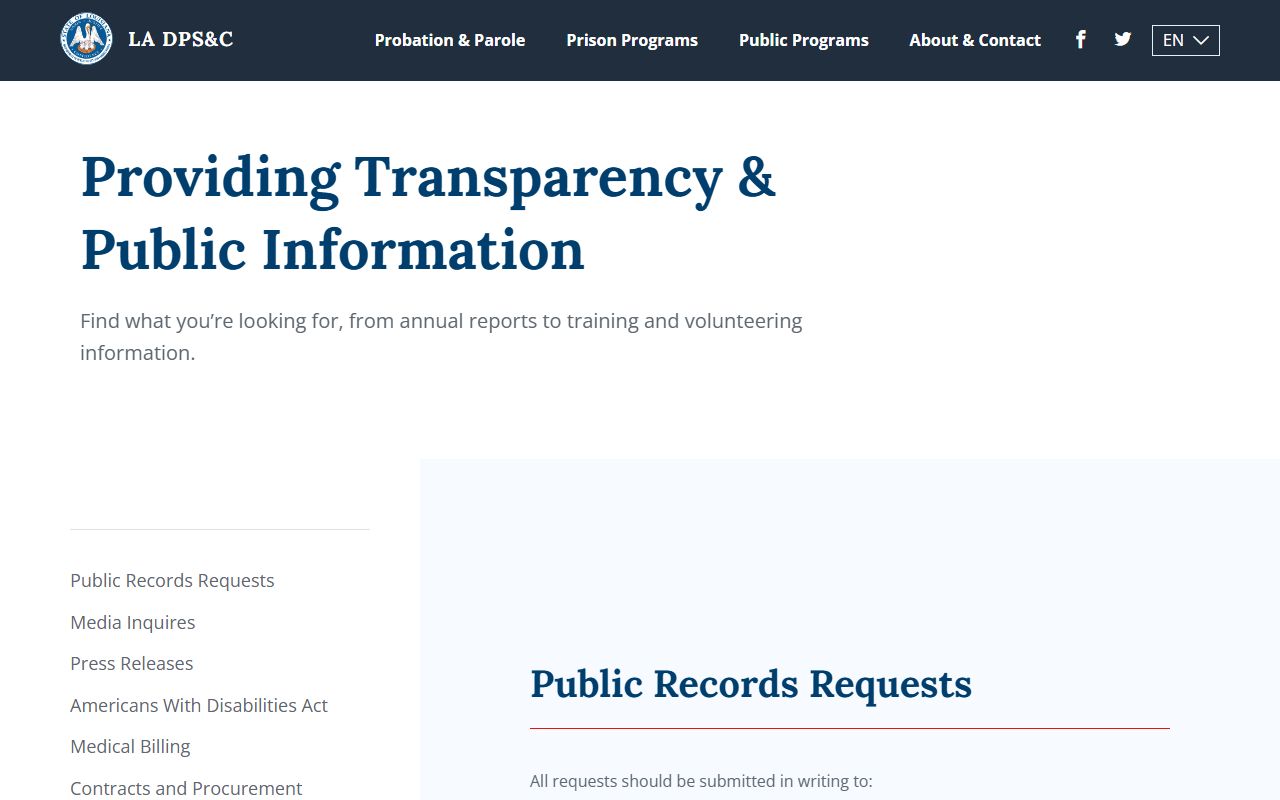
Public records requests to the Department of Corrections go to the Deputy Secretary's Office. Mail to: La. Department of Public Safety and Corrections, Attn: Deputy Secretary's Office, P.O. Box 94304, Baton Rouge, LA 70804. Phone: (225) 342-6744. Fax: (225) 342-3095. Email: docpublicrecords@la.gov. Only requests covered by the Louisiana Public Records Act belong at this address. Questions about a specific offender's sentence or sentence computation go elsewhere.
Parish Sheriff Police Records in Louisiana
Each of Louisiana's 64 parishes has a sheriff's office that maintains police records for incidents handled in that area. Parish sheriffs patrol unincorporated areas, run parish jails, and manage their own records divisions. Incorporated cities within a parish may have their own police departments with separate records. Whether you go to the sheriff or the city department depends on where the incident occurred and which agency responded.
Several parishes offer free online tools for looking up certain public records. Caddo Parish Sheriff's Office maintains an inmate lookup page and an active warrants database. Calcasieu Parish provides a free online inmate lookup and public access terminals at the courthouse. Lafayette Parish Sheriff's Office runs JADES, a Live Jail Database showing current inmates and recent bookings within the last 48 hours. Bossier Parish Sheriff's Office keeps an online Inmate Search Tool searchable by name or booking date, plus a Sex Offender Locator. East Baton Rouge Parish Clerk of Court offers free court date searches online through the ClerkConnect system. Tools, fees, and processes vary across parishes, so always check directly with the local office for what they provide.
Under La. R.S. 44:1, any person 18 or older may inspect or copy public records from any state or local agency. The custodian must respond within three business days. You may be charged for copies but not for simple inspection at many offices. Some parishes allow free onsite review at the sheriff's office before deciding whether to order copies.
Browse Louisiana Police Records by Parish
Each parish has its own sheriff's office and records division. Pick a parish below to find local contact info, procedures, and resources for police records in that area.
View All 64 Louisiana Parishes
Police Records in Major Louisiana Cities
Residents of larger cities may request police records through city police departments or their parish sheriff. Pick a city to find local resources for police records in that area.